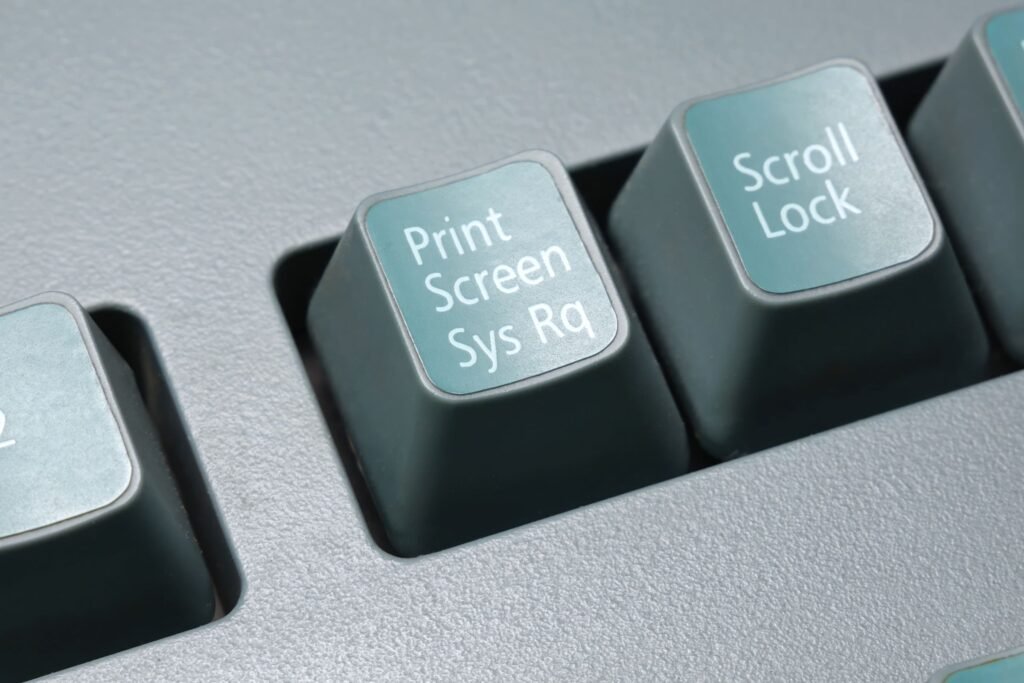
The first time I saw a “screenshot” used as proof, it wasn’t even a screenshot. It was a photo of a CRT monitor, taken with a disposable camera, the kind that gave you a soft blur and a bright flare where the glass caught the light. Someone had printed it out and brought it to a meeting as evidence that a colleague had “said the thing” in an internal chat. The room argued about intent, not authenticity. Back then, the idea that the image itself might be staged felt like paranoia.
That is what makes screenshot forgery such a quietly perfect crime. It piggybacks on a cultural habit. We trust rectangles.
From the late 1990s to the mid-2020s, the fake screenshot evolved from a fiddly prank into a routine instrument of persuasion. Along the way it picked up new costumes: IRC windows, AOL Instant Messenger, SMS bubbles, WhatsApp threads, Discord servers, Instagram DMs, email headers, bank transfers, airline confirmations, moderation logs. The look changed; the wager stayed the same. If it looks like the interface you recognize, you will treat it like a witness.
1998–2002: When “Print Screen” felt like truth
In 1998, the screenshot was still mostly a technical artifact. You hit Print Screen, pasted into Paint, cropped the edges, and saved as a BMP or a JPEG with the kind of compression that left mosquito noise around every letter. Screens were small. Fonts were jagged. Every capture looked, in a sense, already damaged, which oddly made them feel honest. Nobody expects a courtroom sketch to be high-resolution.
Forgery existed, but it took effort. You needed to know how to edit pixels, or at least how to swap text in an image without obvious seams. That barrier mattered. It kept the practice in the hands of hobbyists and office jokers.
The earliest screenshot fakes I remember hearing about were petty and local: an altered ICQ message log to start a fight, a doctored forum post to “prove” a moderator was biased, a fake Windows error dialog designed to prank a friend. The deception often depended less on perfect typography than on social momentum. People wanted to believe what fit their existing story about someone.
And because screenshots were still novel, they carried the sheen of machinery. “The computer says so” has always been persuasive.
2003–2007: Instant messaging gets a template, and so does lying
As chat became a default mode of communication, so did the screenshot. AIM, MSN Messenger, Yahoo! Messenger, IRC clients with customizable skins, early webmail interfaces. Each platform offered a consistent visual grammar: user list on the side, timestamps, colored names, a particular shade of gray for the chat background. Consistency is wonderful for usability. It is also wonderful for counterfeiting.
The forgeries got cleaner. Editing software improved, and more people learned the basics. The easiest path was simple: change the words, keep everything else. Cropping became a tactic. So did selective capture. If you can’t convincingly alter the conversation, you can slice out the parts you don’t like.
This era also taught a lesson that would repeat: the screenshot does not need to be perfect, it just needs to arrive first. In an argument, the first image to circulate tends to become the “original,” and the burden shifts to anyone who doubts it.
2008–2012: The smartphone makes screenshots everyday evidence
The iPhone didn’t invent the screenshot, but it domesticated it. Suddenly everyone could capture what they saw without knowing anything about file formats. One button combination, a shutter sound, a little flash. A moment later, the image sat in the same camera roll as your vacation photos. That proximity mattered. It turned screenshots into life documentation.
At the same time, texting moved from carrier SMS to app-based messaging. Interfaces became slicker and more standardized: speech bubbles, read receipts, avatars, muted color palettes. The screenshot began to look like an object designed for sharing. You could send a screenshot of a conversation within the same conversation, a loop of evidence-making.
Forgery followed the path of least resistance. People discovered that you didn’t always need Photoshop. You could rename contacts, change profile photos, adjust the phone’s time, or exploit the way notifications displayed on locked screens. Sometimes the “fake” was a performance more than an edit: stage the conditions, then capture reality.
And there was another shift. Screenshots were no longer proof shown to a few people in a room. They were posted.
2013–2016: “Receipts,” callout culture, and the politics of the crop
By the mid-2010s, social platforms taught a new rhetorical move: post the receipts. A screenshot of a DM was a mic-drop. It did not merely support your claim, it became the claim. Entire narratives were built from a handful of cropped bubbles.
This is where forgery became less about technical manipulation and more about narrative construction. You could omit the provocation and publish only the reaction. You could cut off the date, hide the context, remove the previous messages that made the next line make sense. A screenshot can be authentic and still misleading, and that ambiguity gave plausible deniability to people who wanted to weaponize it.
Meanwhile, the demand for certain kinds of “proof” rose. Brands wanted to show customer messages praising a product. Influencers wanted to show that celebrities had noticed them. Students wanted to show that a teacher had said something outrageous. In every case, a screenshot served as a shortcut: it was faster than quoting and felt harder to dispute.
The more we treated screenshots as a currency, the more we created incentives to counterfeit them.
2017–2019: The generator era begins, and anyone can print a lie
At a certain point, the craft gets productized. The same way music production moved from studios to laptops, screenshot forgery moved from image editors to specialized tools. You no longer had to understand fonts or kerning or how to fake a status bar. You could select a platform, type the messages, choose the time, toggle read receipts, and export.
One reason those tools spread is that they serve legitimate needs, too. Comedy writers use mock chats as punchlines. UX designers use them to storyboard flows. Teachers build examples for lessons about media literacy. Film and TV productions need realistic interface screens without violating privacy.
But the same convenience that makes it useful makes it dangerous. If you can generate a fake whatsapp chat in a minute, the bottleneck is no longer technical skill. It is judgment. And judgment is exactly what weakens when something aligns with your beliefs or when the social reward for sharing is immediate.
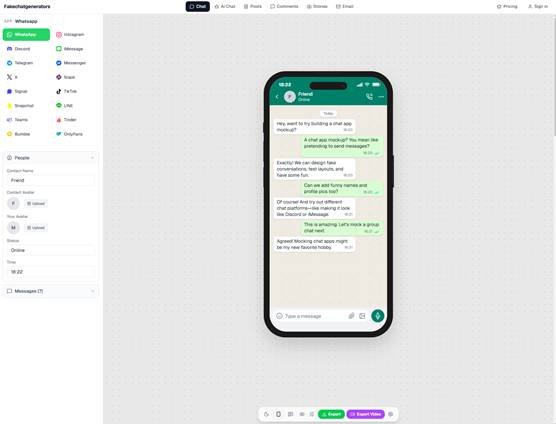
fakechatgenerators.com lets you mock up chat screenshots across 16 platforms
This is also when “screenshot” becomes shorthand for a whole category of forgery. You might not even need an image. You could post a screenshot-like graphic, or a text recreation in the same style. The important part was the feeling: here is a captured truth, sealed in pixels.
2020–2021: The pandemic years, the remote workplace, and the administrative screenshot
Remote life made screenshots bureaucratic. We captured Zoom invites, Slack messages, Microsoft Teams announcements, Discord posts, ticketing systems, moderation notes. People began to store screenshots not just as gossip but as insurance.
That created a strange dynamic. In many workplaces, a screenshot became a substitute for process. Instead of a formal incident report, there was a screenshot of a chat thread. Instead of a documented decision, there was a screenshot of someone saying “ok.” This made the screenshot feel like an official record, even when it lacked metadata, context, or any guarantee of completeness.
At the same time, the stakes rose. A forged chat screenshot could cost someone a job, trigger harassment, or spark a community pile-on. The harm was no longer limited to embarrassment. It could be material.
The forgeries also got subtler. It wasn’t just “look what you said.” It was “look what the company promised,” “look what the moderator admitted,” “look at this transaction,” “look at this email header.” A screenshot of a bank app, even if obviously fake to an expert, could still work on a hurried customer service rep or a casual observer.
2022–2024: Generative AI enters the scene, and the trust gap widens
Once generative AI image tools became broadly accessible, the screenshot problem gained a cousin: the synthetic “photo” of a screen, the fabricated UI, the plausible-looking document, the simulated notification. The question shifted from “did someone edit this?” to “did this ever exist?”
This also introduced an arms race in perception. Human eyes are good at spotting certain kinds of errors, weird spacing, inconsistent shadows, a status bar that doesn’t match the phone model. But as tools improve, the tells move. The errors get smaller and more platform-specific. And because interfaces change frequently, your memory of what is “normal” may be outdated.
The result is not just more fakes, but more doubt. Even real screenshots can be dismissed as “AI.” People who want to escape accountability can claim that anything inconvenient is fabricated. That is the most corrosive effect: not that we believe lies, but that we stop believing anything.
In response, detection tools and verification workflows became more common. Newsrooms and trust and safety teams began treating images as suspect by default. Products such as an ai image detector marketed speed and scale, with claims like 98.7% detection accuracy across 50+ generative models and sub-150ms latency, aimed at the practical reality that moderation and verification often happen under pressure.
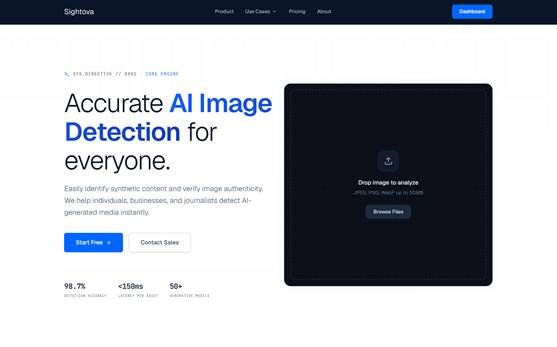
sightova.com flags AI-generated, tampered, NSFW, and violent imagery in milliseconds
Still, detection is not the same as certainty. A detector can flag patterns, but it cannot restore missing context, nor can it easily answer the oldest screenshot question: what happened right before, and what happened right after?
2025–2026: The screenshot as a contested object
By 2026, the screenshot sits in a peculiar place. It remains one of the most persuasive forms of everyday evidence, yet it is also widely recognized as forgeable. People share them with captions like “if true” and “can anyone verify,” performing skepticism while still amplifying the claim. Platforms add friction in some contexts, but friction is uneven and often comes after the image has done its work.
Meanwhile, the forgery ecosystem has matured. There are templates for almost every major messaging app and social platform. There are communities that trade “clean” UI assets. There are services that will fabricate entire histories, complete with plausible usernames and timestamps. The tools keep adding features that sound innocent on paper, because they are innocent in some uses: exporting higher resolution, matching dark mode, simulating different device frames.
The deeper change is cultural. We have begun to treat screenshots less like photographs and more like performances. A screenshot is not only “what happened.” It is also “how someone wants you to feel about what happened.” The crop, the highlight, the circle in red marker, the underlined timestamp, the choice to blur one name but not another. Even an authentic screenshot is a piece of editing.
In some corners, people have responded by shifting what they consider persuasive. Screen recordings, logs, original message exports, or in-person confirmation. But each alternative has its own vulnerabilities. A screen recording can be staged. Logs can be cherry-picked. Exports can be altered. Trust is not a single technology problem. It is a system problem, and systems are made of incentives.
What hasn’t changed since 1998
Looking back to that grainy photo of a CRT, I’m struck by how little the human part has changed. The technology moved from Paint to generators, from pixel edits to synthetic media, from casual fakes to industrial-scale misinformation. But the mechanism is familiar.
A screenshot works because it feels like a capture, not a claim. It borrows authority from the interface itself. The platform’s design becomes a costume for truth.
That’s why screenshot forgery keeps resurfacing. It is adaptable. It can be silly or cruel. It can be intimate or political. It can happen in a group chat of five people or in front of five million.
And the lesson, if there is one, is annoyingly unromantic. Verification is rarely dramatic. It is mundane and slightly tedious. Ask for more context. Ask for a longer thread. Check whether the UI matches the device and date. Consider motives, including your own. Be slow when something makes you instantly angry.
The rectangle will keep insisting it is a witness. Our job is to remember it is only a picture, and pictures have always been easy to stage.